Our approach
Optimized beta
Broad market exposure, sized against risk as the market prices it today. Beta is the return for bearing market risk rather than for picking winners; optimized means the amount of it we carry is solved for, continuously, instead of being set once and left. What we optimize is not the source of the return but how much of it to hold, and in what mix.
The objective is long-term growth of capital.
We hold broad exposure across a diversified set of markets and seek to be paid over time for bearing that risk. We do not try to identify mispriced securities and we do not time the market.
One decision, made continuously.
How much market risk to carry, and in what mix. Every portfolio answers it, deliberately or by default, and our process is built around nothing else.
What we optimize is not the source of the return. It is how much of it to carry, and in what proportion, given what risk looks like today.
We measure risk where it is priced.
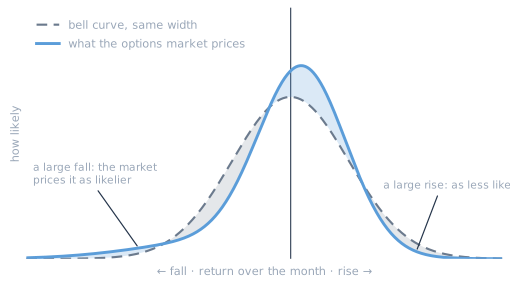
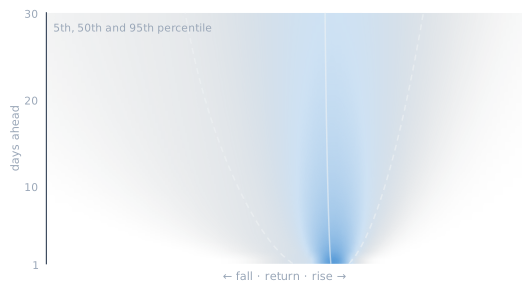
Listed options are priced continuously by participants with real capital at risk, and read together they give something no average can: the full range of outcomes the market currently expects for an asset, including how much likelier it makes a sharp decline than a sharp rally of the same size. We regard reading that board accurately as our principal competence.
That view changes when the market changes its mind. A historical estimate changes when a lookback window rolls over. It also treats a decline as the mirror image of a rally, and it is least reliable when conditions are changing, which is when the answer matters most.
We read option prices for what they say about risk. That reading does not depend on the market being wrong about anything — if the board is mispriced, our picture inherits the error rather than profiting from it.
Option prices carry a premium. We take it out.
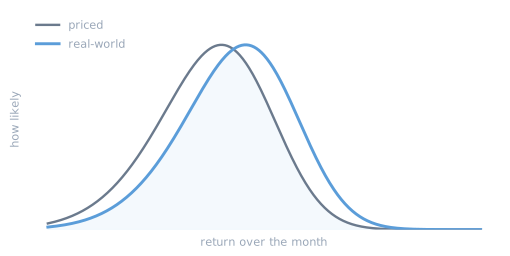
Insurance costs more than the average loss it covers, because the insurer has to be paid to carry the risk. Options work the same way. Protection against a decline is something many investors want and few want to sell, so it is priced above what history alone suggests.
That premium is the payment an investor earns for bearing risk, so we estimate it and remove it before sizing anything. The shape of each asset's risk — its width, its asymmetry, the weight of its tails — still comes from the market.
The premium does not. No price anywhere reveals it, which makes it the least certain input we use. We treat it conservatively for that reason, and we are sceptical of anyone claiming precision about it.
No market prices correlation. So we forecast it.
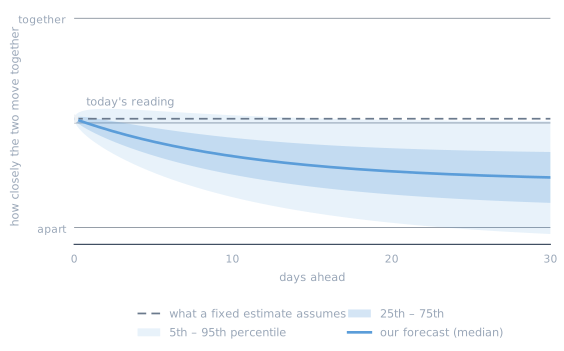
An option board describes one asset at a time. Nothing liquid prices how two assets move together, so that part has to be estimated rather than read.
We estimate it from how the assets have actually moved, and then we forecast how it changes over the holding period instead of holding it fixed. Relationships that hold in calm markets often break in stressed ones. A process that assumes they are constant is sized for the wrong conditions.
We size for compounding, not for a risk target.
Volatility targeting and risk parity fix a level of risk and solve for the holdings that deliver it. We do the reverse, and we believe it is the right way round: we solve for the holdings that compound fastest against the risk the market is pricing, and the level of risk falls out of that rather than being chosen in advance.
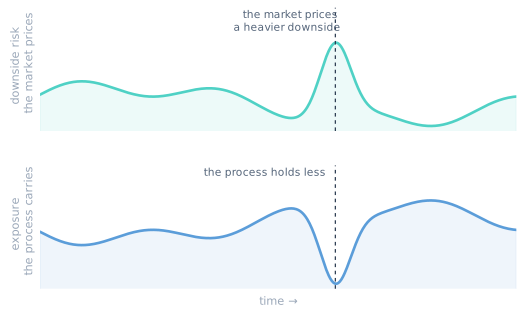
So it moves. When the market prices a heavier downside, we hold less. When it does not, we hold more.
Compounding is unforgiving: a portfolio that loses everything once cannot recover. The objective scores that outcome as infinitely bad, so sizes carrying a real chance of it are rejected by the objective itself rather than by a limit bolted on afterwards. That is a property of the arithmetic, not a guarantee of any outcome.
Machine learning builds the system. It does not pick the positions.
We use machine learning heavily, and it is worth being exact about where. It goes into the engineering: writing and improving our code, sharpening the process that turns an option board into a sized portfolio, and generating the tests our models are measured against. It has made us faster at the parts of this that are software problems.
It does not make investment decisions and it is not a source of advice. What we hold, and how much of it, comes out of the process described above — explicit, inspectable, and the same every time it is run. We believe a step that cannot account for its own reasoning has no business being the one that sizes a position.
What to expect.
This is a market-exposed strategy. It is not hedged, market-neutral, or absolute-return. Investors should expect returns to be substantially correlated with broad markets and to decline when markets decline. Over shorter periods the strategy may underperform simpler approaches, and its returns may be more variable than some investors expect. The approach is designed for long holding periods.
What the strategy is, and is not.
It is
- Systematic and rules-based
- Multi-asset, broadly diversified
- Market-exposed: it seeks the return for bearing risk
- Sized against a forward-looking, market-implied view of risk
- A process whose risk level is an output
- Informed by option prices
- Designed for long holding periods
It is not
- Discretionary or opinion-driven
- A single-market or single-factor product
- Alpha: it does not seek mispriced securities
- Sized against historical volatility alone
- Volatility targeting or risk parity, which fix risk in advance
- A hedged, market-neutral, or absolute-return strategy
Judge the forecast now. Judge the returns later.
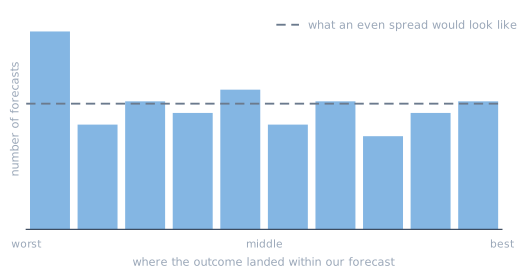
Each time we set positions we record a forecast of the full range of outcomes. When the outcome arrives we note where it fell inside it.
If the forecasts are right, those positions spread evenly: about one in ten below the tenth percentile, one in ten above the ninetieth. A process that understates risk piles outcomes at the extremes. One that overstates it piles them in the middle. Neither can be hidden.
That can be checked now, so judge us on it now. Returns need a history long enough to mean something, and nothing shortens that.
Further reading.
Our methodological note sets out every step, the research behind it, and the limits of both. Available on request to institutional investors, investment firms and qualified investors at qualified_investments@objectivedynamix.com.